
Khai Dinh Tomb in Hue: 7 Amazing Reasons to Visit
Khai Dinh Tomb in Hue is one of the most visually striking historical sites in Vietnam. Perched on the slopes of Chau Chu Mountain, the mausoleum looks compact from the outside, yet every staircase, courtyard, statue and mosaic reveals another layer of the story behind Emperor Khai Dinh and the final decades of the Nguyen Dynasty.
If you are planning a trip to Hue and want to experience more than the Imperial City, Khai Dinh Tomb in Hue deserves a place on your itinerary.
It is not simply a royal burial site. It is an architectural statement shaped by Vietnamese traditions, Asian decorative arts and strong European influences during a period when Vietnam was undergoing significant cultural and political change.
Why Visit Khai Dinh Tomb in Hue?
Among the royal mausoleums around Hue, Khai Dinh Tomb in Hue has a personality of its own.
Many Nguyen royal tombs are designed as large landscapes where architecture, gardens, lakes and hills flow together. Khai Dinh is different. It rises vertically up the mountain, using terraces and stairways to create a dramatic sense of movement.
The tomb is part of the Complex of Hue Monuments, which was inscribed on the UNESCO World Heritage List in 1993. UNESCO describes Hue as an exceptional example of an imperial capital where architecture, urban planning and the surrounding natural landscape were carefully integrated.
UNESCO World Heritage Centre – Complex of Hue Monuments
What makes Khai Dinh Tomb in Hue especially memorable is the contrast between its exterior and interior.
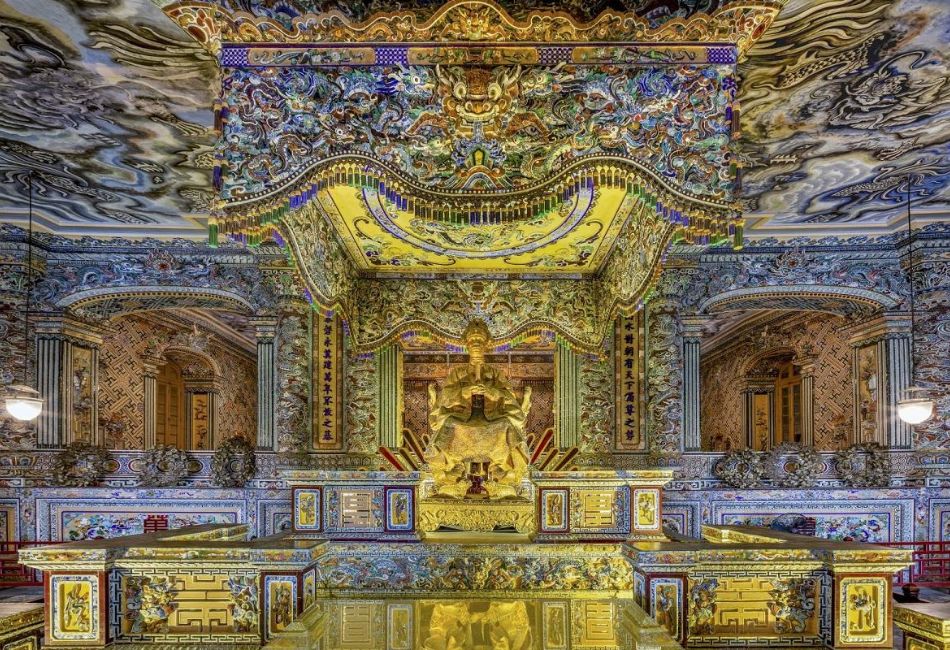
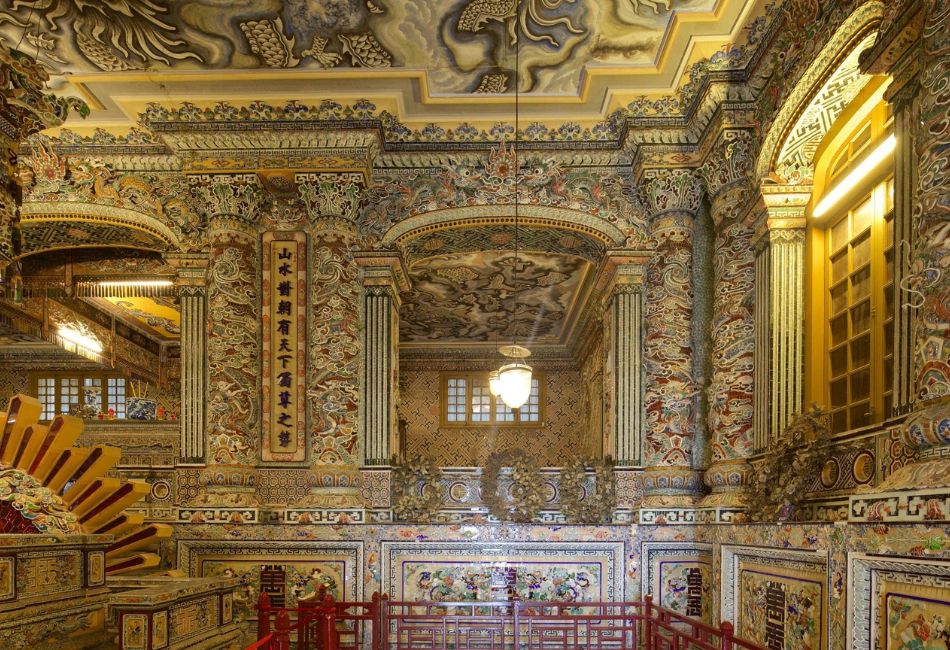
From a distance, the mausoleum appears grey, solemn and almost fortress-like. Step inside Thien Dinh Palace, however, and the atmosphere changes completely. Colourful ceramic and glass mosaics, decorative motifs and intricate details cover the walls and ceilings.
For travellers who enjoy architecture, history and photography, this contrast makes the site particularly rewarding.
Who Was Emperor Khai Dinh?
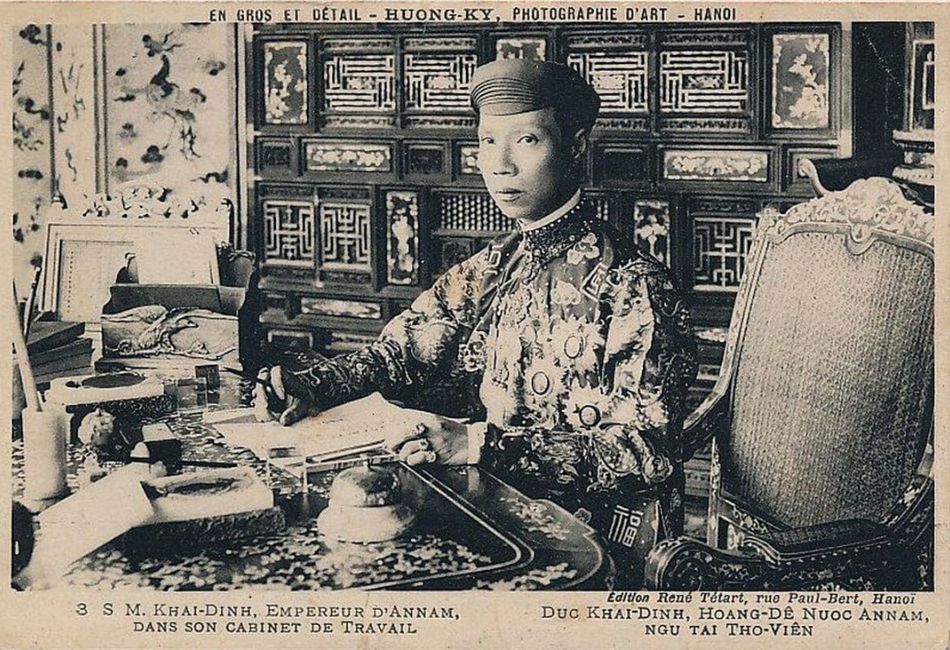
Emperor Khai Dinh was the 12th emperor of the Nguyen Dynasty, reigning from 1916 to 1925.
His reign took place during a complicated period in Vietnamese history, when Vietnam was under the French colonial system and European influence was increasingly visible in politics, architecture and everyday life.
Khai Dinh was known for his interest in architecture and decorative arts. His mausoleum reflects this personal taste and the changing cultural environment of early 20th-century Hue.
Understanding this background makes Khai Dinh Tomb in Hue much more interesting.
Instead of seeing it simply as an extravagant royal monument, visitors can view it as a record of a transitional period when traditional Vietnamese imperial culture encountered new materials, foreign artistic influences and modern construction techniques.
The History Behind Khai Dinh Tomb in Hue
Construction of the mausoleum began on September 4, 1920, on Chau Chu Mountain.
The project continued for 11 years and was completed in 1931, six years after Emperor Khai Dinh died in 1925. His successor, Emperor Bao Dai, oversaw the completion of the project.
The Vietnam National Authority of Tourism describes the tomb as a relatively compact but highly elaborate structure, measuring approximately 117 metres by 48.5 metres.
The tomb’s construction is particularly interesting because it combines reinforced concrete and other modern materials with traditional imperial symbolism and Asian decorative arts.
According to Vietnam Tourism, the overall structure rises through 127 steps, creating a powerful vertical composition against the mountainside.
Vietnam National Authority of Tourism – Tomb of Khai Dinh
The result is very different from the spacious garden landscapes associated with some earlier Nguyen emperors.
Rather than spreading horizontally, Khai Dinh Tomb in Hue leads visitors upward, terrace by terrace, toward the central palace.
The 127 Steps and Dramatic Architecture
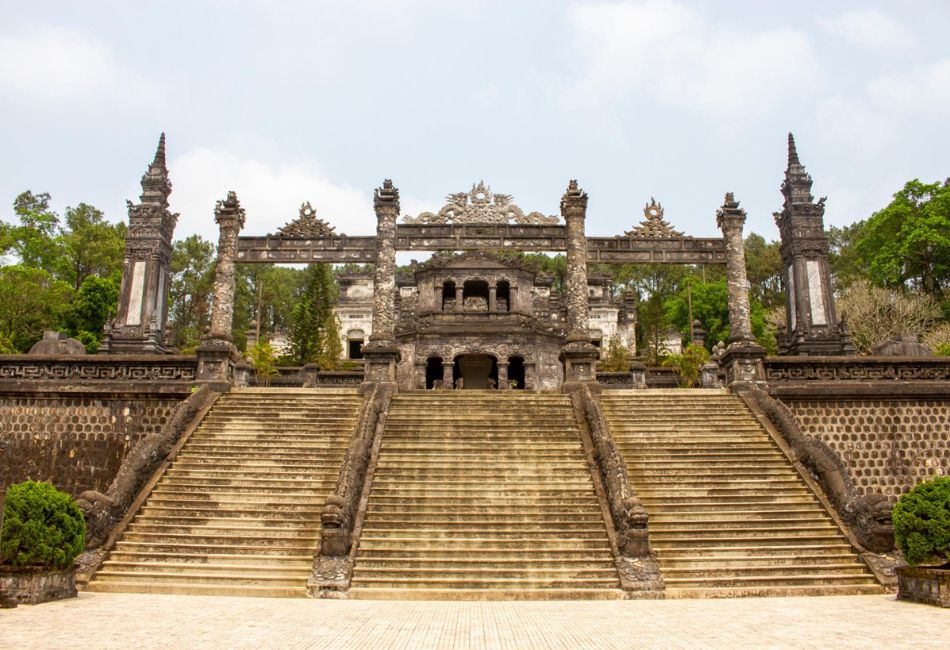
One of the first things you notice at Khai Dinh Tomb in Hue is the staircase.
The entire mausoleum is arranged vertically along the mountain slope, with a total of 127 steps distributed across different levels.
The stairways are decorated with dragons, carved stone details and ornamental elements. The climb itself becomes part of the experience.
Take your time as you go upward.
Stop occasionally and look back toward the countryside. From higher levels, the surrounding landscape becomes more visible, creating an interesting contrast between the imposing architecture and the green hills beyond.
The Vietnam National Authority of Tourism notes that visitors pass through several ascending sections before reaching the main palace, creating a carefully staged journey through the mausoleum.
For photographers, these staircases also create excellent perspectives.
The repeating lines, stone dragons and symmetrical terraces give the site a dramatic visual character that is very different from other royal tombs in Hue.
The Honour Courtyard and Stone Mandarins
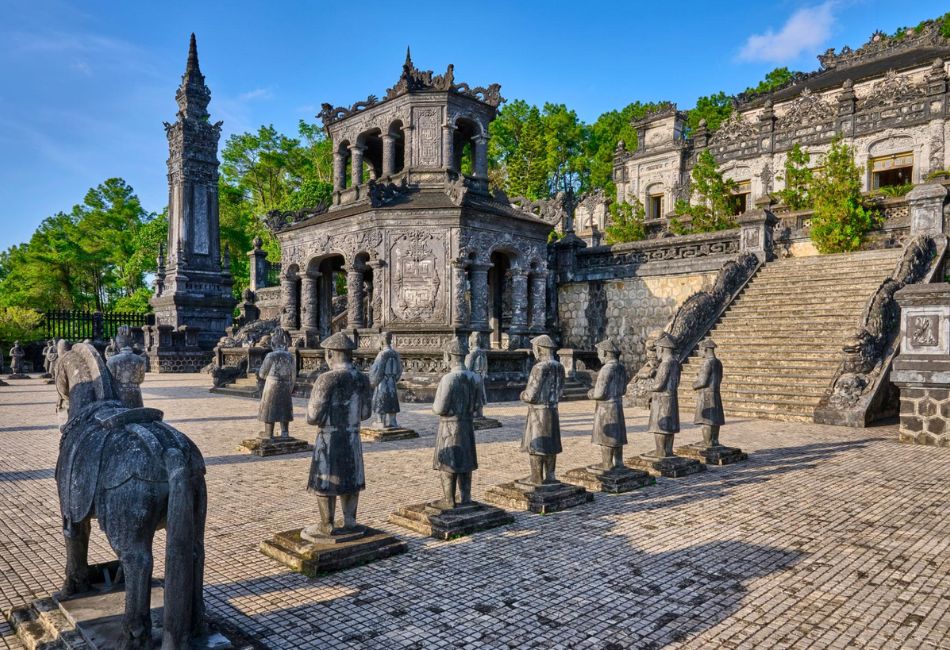
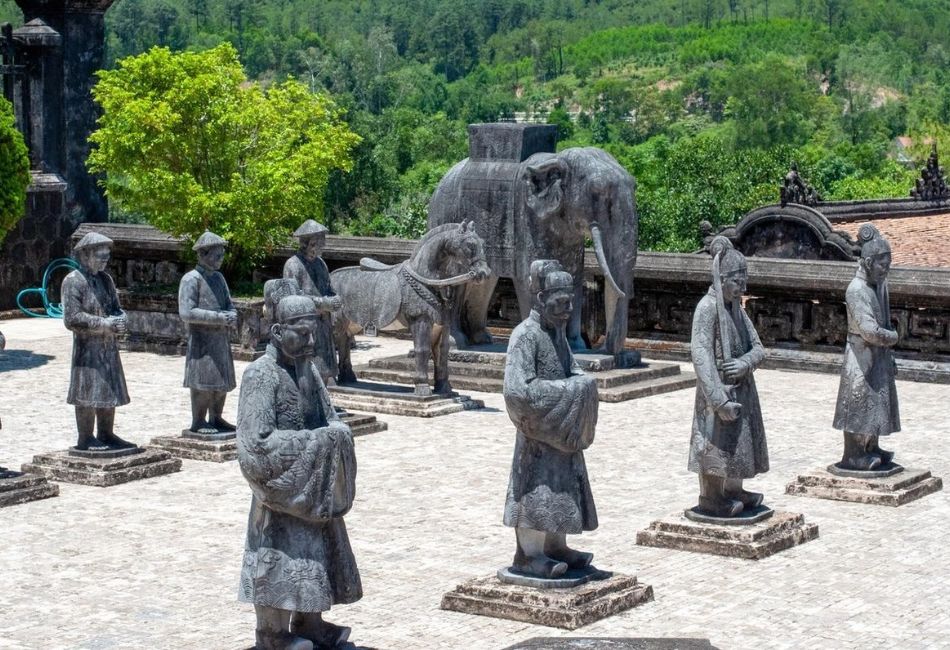
After climbing through the lower sections, visitors arrive at the Honour Courtyard, one of the most important ceremonial spaces in the mausoleum.
Rows of stone figures stand facing the centre, including mandarins, soldiers, horses and elephants.
These figures represent the imperial court and reflect the traditional belief that the emperor would continue to have attendants and protection in the afterlife.
Look closely at the statues rather than simply walking past them.
Their clothing, poses and expressions contribute to the ceremonial atmosphere of the courtyard.
The courtyard is also one of the best places to appreciate the symmetry of Khai Dinh Tomb in Hue.
From here, the terraces above form a strong visual axis leading toward Thien Dinh Palace.
Thien Dinh Palace: The Artistic Heart of Khai Dinh Tomb in Hue
If you only have time to focus on one part of Khai Dinh Tomb in Hue, make it Thien Dinh Palace.
Located at the highest level of the mausoleum, Thien Dinh Palace is the artistic centre of the entire complex.
The exterior is imposing and richly decorated, but the interior is where the craftsmanship becomes truly remarkable.
Walls and ceilings are covered with intricate mosaics made from ceramic and coloured glass. Dragons, flowers, clouds and other symbolic motifs appear throughout the rooms.
The small pieces are carefully arranged to create detailed patterns and a sense of depth.
The interior also contains the emperor’s statue, altar and burial area.
This dramatic change—from grey stone outside to colourful decoration inside—is one of the most memorable moments of visiting the tomb.
Vietnam Tourism describes the Khai Thanh Palace within Thien Dinh Palace as being densely decorated with glass and porcelain designs, while the ceiling features a famous dragon composition.
The Famous Nine Dragons Mural
One detail that deserves special attention is the Nine Dragons mural on the ceiling.
Dragons were closely associated with Vietnamese royalty, imperial authority and power.
Seeing them moving through clouds above the main interior creates a strong connection between the architecture and the symbolic world of the Nguyen court.
The ceiling is easy to miss because visitors naturally focus on the statue and colourful walls.
So remember to look up.
The mural is an excellent example of how Khai Dinh Tomb in Hue combines traditional Vietnamese symbolism with an unusually elaborate decorative style.
East Meets West at Khai Dinh Tomb in Hue
Perhaps the most fascinating feature of Khai Dinh Tomb in Hue is its architectural fusion.
The mausoleum incorporates Vietnamese and Asian traditions while also showing strong European influences.
You can see this combination in the arches, columns, decorative treatment, construction materials and overall architectural composition.
At the same time, dragons, lotus motifs, imperial symbols and traditional decorative themes remain central to the design.
The official Vietnam Tourism description characterizes the tomb as an intermingling of European and Asian architectural trends.
This mixture reflects the cultural environment of early 20th-century Vietnam.
Rather than simply copying the architectural style of earlier Nguyen emperors, Khai Dinh’s mausoleum represents a new visual language.
It is traditional and modern at the same time.
That is one of the main reasons why the tomb feels so different from Minh Mang Tomb or Tu Duc Tomb.
What to Notice When Visiting Khai Dinh Tomb in Hue
The best way to experience Khai Dinh Tomb in Hue is to slow down.
Do not simply climb the stairs, take a quick photograph and leave.
Start with the dragon railings and stone carvings.
Then spend time in the Honour Courtyard and look carefully at the stone mandarins, horses and elephants.
Once inside Thien Dinh Palace, examine the mosaics closely.
You will notice that many decorative surfaces are made from countless small pieces of ceramic and coloured glass.
Look at the ceiling as well.
The longer you spend inside, the more details you are likely to discover.
This is particularly important because the tomb is relatively compact. You can explore the main areas in a short amount of time, but the details reward a slower visit.
Best Time to Visit Khai Dinh Tomb in Hue
Hue can be hot and humid, so choosing the right time of day can make your visit more comfortable.
Early morning is a good choice if you prefer cooler temperatures and softer light.
Late afternoon can also be pleasant, particularly for photography.
Because the site contains many steep stairways, comfortable shoes are essential.
Bring water, sunscreen and a hat during sunny weather.
If rain is forecast, carry an umbrella or light rain jacket. The stone steps can become slippery when wet, so take your time.
Ticket Price and Practical Travel Tips
According to the Hue City Portal, the current entrance ticket for the royal tombs of Emperor Minh Mang, Emperor Tu Duc and Emperor Khai Dinh is 150,000 VND for adults and 30,000 VND for children aged 7–12. The listed prices apply from January 4, 2026.
Hue City Portal – Official Monument Ticket Information
Because ticket policies can change, it is always a good idea to check the official information before travelling.
The tomb is located on the slope of Chau Chu Mountain, around 10 km from Hue city centre.
For a comfortable visit:
- Wear comfortable walking shoes.
- Bring drinking water.
- Use sunscreen and bring a hat on sunny days.
- Allow enough time for the stairways.
- Avoid rushing through the interior mosaics.
- Bring a camera—the architecture offers many excellent photo angles.
Khai Dinh Tomb vs Minh Mang Tomb
If you have enough time, visiting both tombs is highly recommended.
The contrast between them is fascinating.
Minh Mang Tomb is spacious, balanced and closely connected with nature. Its architecture, gardens, lakes and surrounding landscape create a peaceful and harmonious atmosphere.
Khai Dinh Tomb in Hue is more compact, vertical and intensely decorative.
One feels like an imperial garden.
The other feels like an architectural jewel built into a mountainside.
Seeing both helps visitors understand how different Nguyen emperors expressed their ideas about power, nature, spirituality and royal identity.
The official Vietnam Tourism website also recommends the royal tombs of Minh Mang, Tu Duc and Khai Dinh among Hue’s major historical attractions.
Vietnam Tourism – Discover Hue and Its Royal Heritage
How to Include Khai Dinh Tomb in Your Hue Itinerary
For a first visit to Hue, Khai Dinh Tomb in Hue works particularly well as part of a heritage-focused day.
A classic route could include:
Dragon Boat Ride → Thien Mu Pagoda → Hue Imperial City → Local Hue Lunch → Minh Mang Tomb → Khai Dinh Tomb
This route allows you to experience several important sides of Hue in one day.
If you want to combine royal heritage with rural culture, consider staying longer.
Our Hue Tour 2 Days: Historical Sites and Rural Life Experience combines the Imperial City, Thien Mu Pagoda and royal tombs with a countryside experience in La Chu Village. Hue Tour 2 Days: Historical Sites and Rural Life Experience
For travellers who prefer a countryside-focused experience, the Hue 1 Day Tour: Be A Farmer at La Chu Village offers hands-on farming, farm-to-table cooking and a traditional herbal foot bath. Hue 1 Day Tour: local farming experience in La Chu Village
You can also explore the Hue Countryside Tour, where cycling, local markets, farming and cooking provide a slower perspective on everyday life around Hue. Hue Countryside Tour in La Chu Village
These experiences work well together because they reveal two very different sides of Hue.
The royal monuments tell the story of emperors, dynasties and architecture.
The villages, farms and local families show how Hue’s culture continues through everyday life.
Is Khai Dinh Tomb Worth Visiting?
Absolutely—especially if you are interested in architecture, history and photography.
Khai Dinh Tomb in Hue is not the largest royal tomb, nor is it the most peaceful.
What makes it special is its personality.
The steep staircases create a dramatic entrance.
The stone figures bring the ceremonial world of the Nguyen court to life.
Then Thien Dinh Palace completely changes the atmosphere with colourful mosaics, elaborate decoration and traditional symbols.
It is a place where history feels tangible.
You can see the meeting of old and new, East and West, royal tradition and modern construction techniques.
You can also sense the ambitions of an emperor living at a moment when Vietnam was undergoing profound change.
Conclusion
A visit to Khai Dinh Tomb in Hue is more than a journey into Vietnam’s royal past. From its impressive stairways and stone sculptures to the colourful mosaics inside Thien Dinh Palace, every detail tells a story about Emperor Khai Dinh and a fascinating period of change in Vietnamese history.
If you want to experience Hue beyond the Imperial City, this remarkable royal tomb is well worth adding to your itinerary. Take your time, look closely at the details, and let the architecture reveal the story of Hue’s final imperial dynasty.
Recent Posts
How to Get Thien Mu Pagoda: Complete Hue Travel Guide

Incense Making Village Hue: Discover the Traditional Craft of Thuy Xuan