Hue Culture: A Complete Guide to the History, Traditions, Food and Local Life of Hue
When travellers first arrive in Hue, they often notice the quiet atmosphere before they notice anything else. The city feels different from Vietnam’s larger urban centres, with the Perfume River moving gently through the heart of the city, old trees surrounding ancient temples, and historic buildings standing beside streets filled with modern cafés and local restaurants. But what makes Hue truly distinctive is not simply its monuments. It is the way history, food, spirituality, music, craftsmanship and everyday life continue to exist together. This living heritage is at the heart of hue culture.
Hue is best known as the former imperial capital of Vietnam and the home of the Nguyen Dynasty, which ruled from 1802 to 1945. The legacy of that period remains visible in the Imperial City, royal tombs, temples and ceremonial architecture, but the influence of the imperial era goes much deeper than buildings. It can be seen in the way local cuisine is prepared and presented, in traditional music, in Buddhist practices, in family customs and even in the peaceful relationship between architecture and nature that characterises much of the city.
For travellers who want to understand hue culture, visiting the famous monuments is only the beginning. The deeper experience comes from spending time in local markets, tasting traditional food, listening to Ca Hue, visiting a village, meeting local families or cycling through the countryside. These experiences reveal how the cultural heritage of the former imperial capital continues to live in modern Hue.
This guide explores the history, traditions, food, arts and daily experiences that make hue culture one of the most distinctive cultural identities in Vietnam.
1. What is Hue Culture?
Hue culture is the result of centuries of history, religion, royal traditions, local craftsmanship and everyday community life coming together in one place. While Hue is often introduced to visitors as Vietnam’s former imperial capital, the city’s cultural identity cannot be understood through royal monuments alone. The traditions that developed around the court were gradually absorbed, adapted and continued by local communities, creating a cultural landscape that is both historical and alive.
The city’s cultural character can be seen in many different forms. It is visible in the layout and architecture of the Imperial City, in the quiet atmosphere of Thien Mu Pagoda, in the melodies of traditional Ca Huế music, in the careful presentation of local food and in the farming villages surrounding the urban centre. Even the pace of daily life contributes to the feeling of Hue, where the river, gardens and historic architecture create an environment that encourages people to slow down.
1.1. A City Shaped by Imperial History
The most important influence on hue culture is the city’s history as the capital of the Nguyen Dynasty. When Emperor Gia Long established Hue as the imperial capital in 1802, the city became the centre of political, cultural and ceremonial life in Vietnam.
Royal institutions influenced everything from architecture and music to clothing, cuisine and court rituals. The imperial court also attracted artisans, scholars, musicians and skilled cooks, many of whom helped develop traditions that became part of the wider cultural identity of Hue.
The result was not simply a royal culture isolated behind palace walls. Over time, elements of court traditions entered the lives of ordinary people, while local traditions influenced the cultural life of the court. This relationship between elite and everyday culture is an important part of understanding Hue today.
1.2. The Connection between history and everyday life
One of the most fascinating aspects of hue culture is that historical traditions have not disappeared with the end of the monarchy. They continue through food, music, festivals, architecture and family customs, often in forms that feel very natural rather than formally preserved.
You might see traditional dishes served in a modern restaurant, hear traditional music performed along the Perfume River, or find an old village craft still being practised by a small family workshop. These moments show that culture is not simply something stored in museums. It is something people continue to use, adapt and pass to the next generation.
2. Hue culture and the Nguyen Dynasty
Understanding the Nguyen Dynasty is essential for anyone who wants to understand hue culture. The dynasty shaped the city’s architecture, political importance and artistic traditions for more than a century, leaving behind a heritage landscape that remains central to Hue’s identity.
2.1. Hue as Vietnam’s imperial Capital
Hue served as the imperial capital of Vietnam from 1802 until 1945. During this period, the city became the centre of the Nguyen court and one of the most important political and cultural destinations in the country.
The imperial capital was carefully planned in relation to the Perfume River, surrounding mountains and natural landscape. This relationship between architecture and nature is still one of the defining features of Hue.
UNESCO inscribed the Complex of Hue Monuments on the World Heritage List in 1993, recognising the exceptional historical and architectural importance of the former imperial capital.
For visitors, this means that a walk through Hue is often also a walk through layers of Vietnamese history.
2.2. The imperial city and Royal Heritage
The Imperial City is probably the most recognisable expression of hue culture.
Inside the Citadel, the former royal complex contains gates, courtyards, temples and palaces that were connected to the political and ceremonial life of the Nguyen Dynasty. Although some structures were damaged over time, important parts of the complex remain and continue to reveal how the imperial court was organised. The architecture is filled with symbolism. Colours, decorative motifs, spatial arrangements and ceremonial buildings were influenced by ideas about hierarchy, harmony, spirituality and royal authority.
For travellers visiting the Imperial City, understanding these symbols can make the experience much more meaningful than simply photographing the buildings.
2.3. The Royal Tomb and their cultural meaning
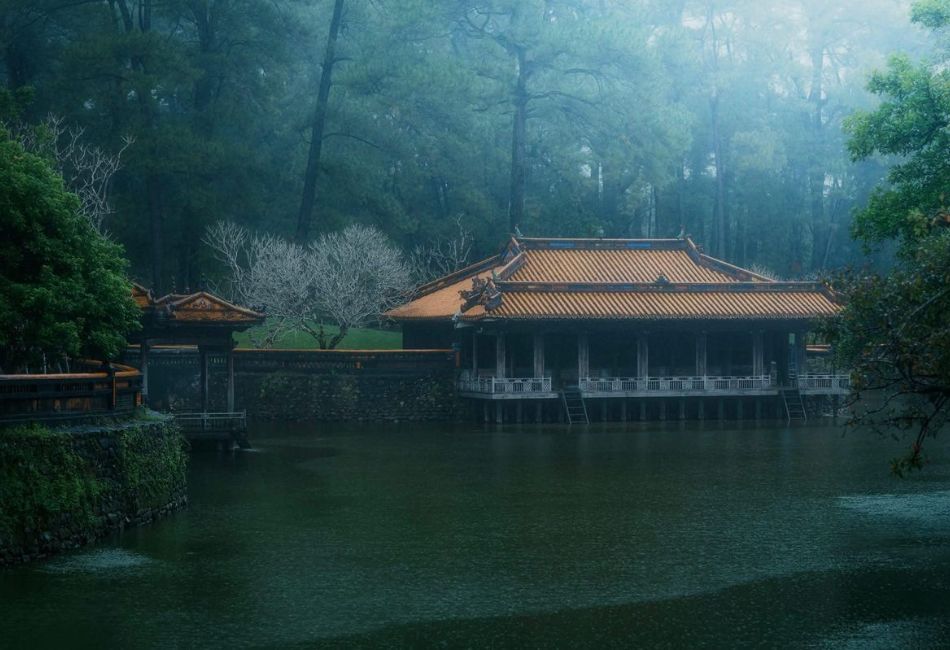
The Nguyen emperors built elaborate tomb complexes in the countryside surrounding Hue, and these places provide another important way to understand hue culture. The tombs were not simply burial sites. They were carefully designed landscapes combining buildings, gardens, lakes, hills and ceremonial spaces. Some emperors used their tomb complexes as places to spend time during their lives as well.
Minh Mang Tomb is known for its symmetry and harmony with nature. Tu Duc Tomb has a more reflective and intimate atmosphere, while Khai Dinh Tomb stands out for its dramatic staircase, elaborate mosaics and mixture of Eastern and European architectural influences.
Each tomb tells a slightly different story about the emperor who created it, allowing visitors to see how personality, religion, landscape and royal identity influenced architecture.
3. Hue culture through food
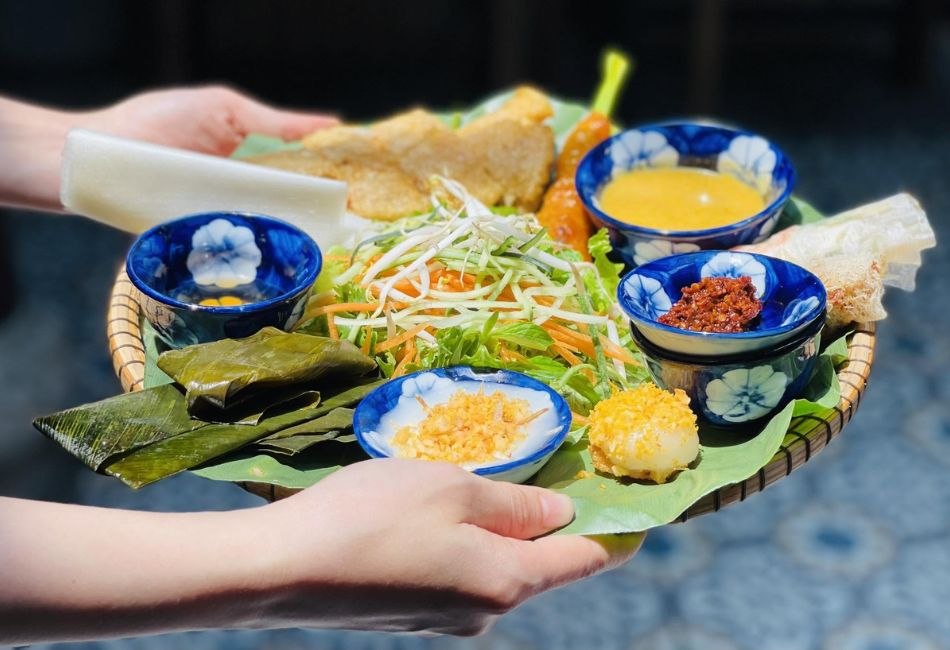
Perhaps nowhere is hue culture more deliciously visible than in the city’s food. Hue cuisine is famous throughout Vietnam for its variety, careful preparation and strong connection to both royal and everyday traditions.
The city’s food culture developed from several influences, including court cuisine, local agriculture, Buddhist traditions and ordinary family cooking. The result is a culinary identity that ranges from refined ceremonial dishes to simple bowls of noodles and small street-food snacks.
3.1. Hue Royal Cuisine
The tradition of royal cuisine is one of the most fascinating parts of hue culture. Food served in the imperial court was expected to meet high standards of preparation and presentation, and dishes were often carefully arranged to look elegant and balanced.
Although modern restaurants do not simply reproduce historical palace meals exactly as they were served, traces of this tradition can still be seen in the way some Hue dishes are presented and prepared.
The emphasis on colour, texture, balance and detail remains an important feature of local food culture.
Travellers interested in this part of Hue can explore traditional dishes at Madam Thu Restaurant, where a range of local specialities can be enjoyed in a relaxed setting.
3.2. Beef noodle soup and everyday food
Beef noodle soup is perhaps the most famous food associated with the city. The dish combines rice noodles with a rich and aromatic broth, traditionally seasoned with lemongrass, chilli and shrimp paste and served with beef, pork and fresh herbs.
What makes Beef noodle soup particularly interesting from a cultural perspective is that it is not simply a “special occasion” dish. It remains part of everyday food life in Hue and is often enjoyed as breakfast.
This connection between famous regional cuisine and ordinary daily habits is an important part of hue culture. You can learn a great deal about the city simply by observing what people eat and where they go for breakfast.
3.3. Beo Cake, Nam Cake, Loc Cake
Small traditional cakes such as Beo Cake, Nam Cake and Loc Cake provide another insight into Hue’s culinary traditions. Each dish uses relatively simple ingredients, but careful preparation gives them distinctive textures and flavours.
Beo Cake consists of small steamed rice cakes topped with savoury ingredients, while Nam Cake is a soft rice cake wrapped in banana leaves and Loc cake is a translucent tapioca dumpling commonly filled with shrimp and pork.
These dishes are often served in small portions, reflecting the refined and detailed approach associated with traditional Hue cooking.
3.4. Sweet Soup and traditional desserts
Hue is also famous for its wide variety of Sweet Soup, or Vietnamese sweet soups and desserts. Some varieties are simple and refreshing, while others are colourful and elaborate, combining beans, fruit, coconut milk, tapioca and other ingredients.
Sweet Soup is often enjoyed as a snack or dessert rather than a formal part of a meal, making it an easy and enjoyable way for visitors to experience another side of hue culture.
4. Hue Culture, Buddhism and Spiritual life
Religion and spirituality are deeply connected to the identity of Hue. Buddhist traditions, family worship and local beliefs continue to influence daily life, ceremonies and community spaces.
4.1. Thien Mu Pagoda
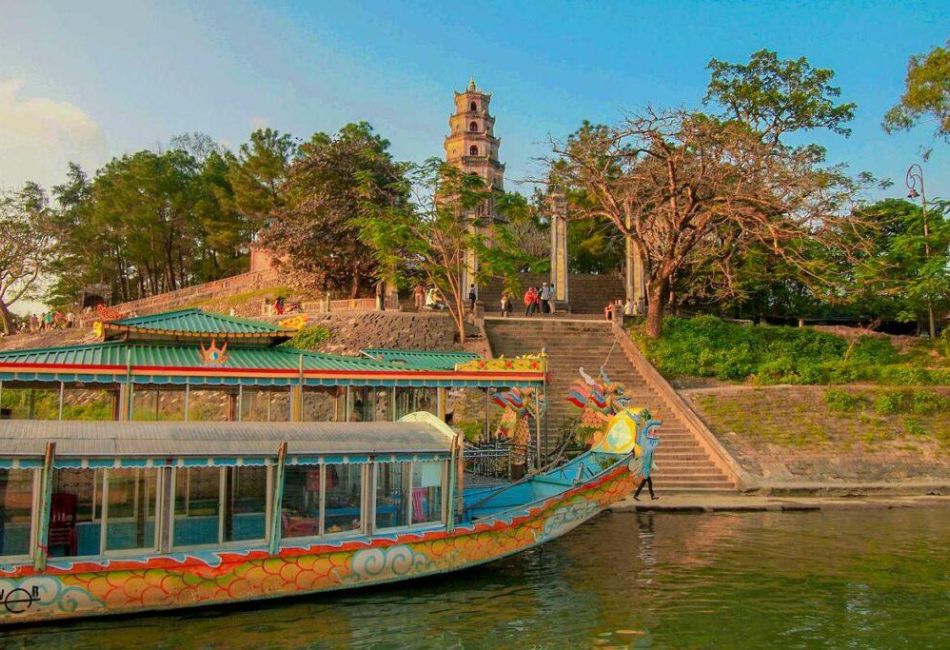
Thien Mu Pagoda is one of the most recognisable symbols of hue culture. Located on Ha Khe Hill overlooking the Perfume River, the pagoda was established in 1601 and has remained an important religious landmark for centuries.
The seven-storey Phuoc Duyen Tower has become an iconic image of Hue, but the wider complex is equally important for understanding the city’s spiritual atmosphere. Visitors can walk through temple courtyards, see ancient trees, hear the sound of the bell and look across the river toward the countryside.
Our Thien Mu Pagoda Hue Vietnam guide explores the history, architecture and cultural significance of this important landmark in greater detail.
4.2. Pagodas, Temples and local beliefs
Beyond Thien Mu Pagoda, Hue has many smaller pagodas, temples and communal houses that remain part of local community life.
These places are often quieter than the famous tourist attractions and can provide a more intimate look at local beliefs. Families may visit temples to pray, make offerings or mark important occasions, while village communal houses can serve as places where community traditions and historical memories are preserved. This spiritual dimension is an important reason why hue culture often feels calm and reflective compared with some larger Vietnamese cities.
4.3. Festivals and Family traditions
Festivals, ancestor worship and family ceremonies continue to play an important role in Hue. These traditions vary between families and communities, but many are connected with respect for ancestors, seasonal cycles and religious beliefs.
Visitors may not always see these traditions directly, but they can often be felt in the way homes, temples and communal spaces are maintained and used.
5. Hue Culture through music and traditional arts
The cultural identity of Hue is not only visual. Music and traditional craftsmanship are equally important.
5.1. Folk music on the Perfume river
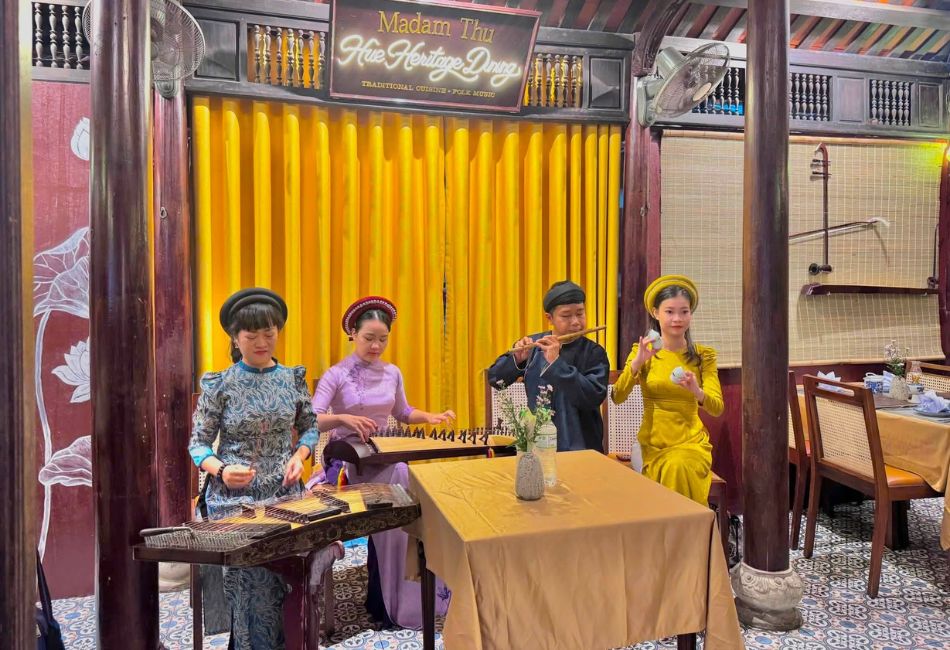
Folk music is one of the most distinctive forms of traditional music associated with the city. Performances often combine singing with traditional Vietnamese musical instruments and have historically been connected to both courtly and local musical traditions.
Listening to Folk music on the Perfume River offers a particularly memorable cultural experience because the music becomes part of the landscape itself.
A traditional boat moves slowly through the darkening river while musicians perform, creating an atmosphere that feels deeply connected with old Hue.
For travellers who want to experience hue culture through sound rather than architecture, a Folk music performance can be one of the most rewarding evening experiences.
5.2. Hue Heritage Dining
For travellers who want to experience hue culture through food as well as music and history, Hue Heritage Dining at Madam Thu offers another way to connect with the city’s traditions. The experience brings together traditional Hue dishes, local culinary heritage and the atmosphere of the former imperial capital, allowing visitors to discover the culture of Hue through a carefully prepared meal rather than simply visiting historical monuments.
The dining experience can introduce guests to traditional Hue flavours while giving them an opportunity to understand the relationship between food and the city’s royal past. The presentation, ingredients and style of the dishes reflect the refined character often associated with Hue royal cuisine, while the setting creates a more immersive connection with the city’s heritage. For international travellers, this kind of experience offers something different from an ordinary restaurant meal because it connects food with stories, traditions and the cultural identity of Hue.
For more information, explore Hue Heritage Dining at Madam Thu, where traditional Hue cuisine becomes part of a wider cultural experience.
5.3. Traditional Crafts and village Heritage
Traditional crafts also contribute to the cultural landscape around Hue. Village communities have maintained skills in food-making, paper crafts, weaving and other forms of handmade production. These activities are important because they show that cultural heritage is not only about grand buildings. It is also about the knowledge and skills held by ordinary families.
Visiting craft villages or meeting local artisans gives travellers a chance to understand how traditional skills continue to survive in a modern economy.
6. Hue culture beyond the imperial city
For many visitors, the biggest discovery is that some of the most rewarding experiences are outside the city centre.
6.1. La Chu Village
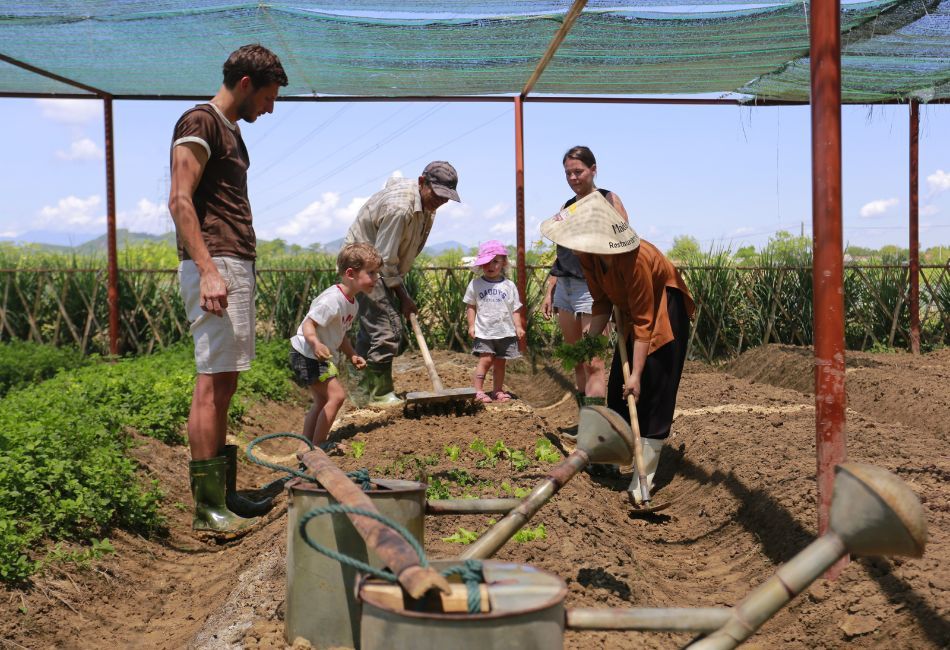
La Chu Village offers a slower and more intimate perspective on hue culture. Surrounded by farmland and vegetable gardens, the village provides a glimpse of the agricultural communities that have long supported life in and around Hue.
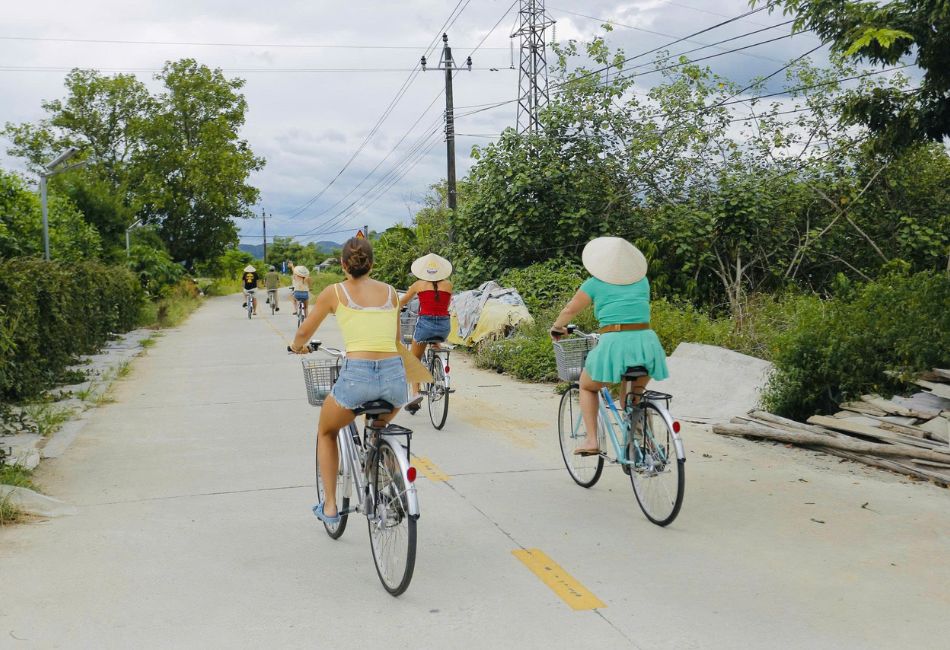
Visitors can explore the village by bicycle, meet local families, walk through vegetable gardens and learn about farming traditions that remain part of everyday life. The contrast with the Imperial City is striking. In the morning you might be surrounded by royal architecture, while later in the day you can find yourself riding along a quiet village road with farmers working in their gardens.
For travellers who want to explore this side of Hue, the Hue Countryside Tour combines village cycling, local markets, farming activities and traditional cooking.
6.2. Local Markets and farming
Local markets are one of the best places to observe hue culture in everyday life. Markets connect the countryside with the city, bringing together fresh vegetables, herbs, spices, seafood and other ingredients.
Walking through a market with a local guide can reveal a surprising amount about local food traditions. You can learn which ingredients are seasonal, how people shop for their families and which foods are important in everyday Hue cooking.
At Madam Thu Farm, visitors can take this experience further by harvesting fresh vegetables and learning how local produce moves from the garden to the kitchen.
6.3. Life along the perfume river
The Perfume River is more than a beautiful background for photographs. It is an essential part of Hue’s cultural landscape, connecting the city with its surrounding villages, temples and historical sites.
A dragon boat ride offers a slower perspective of the city and allows travellers to see landmarks such as Thien Mu Pagoda from the water. The river is especially beautiful in the late afternoon, when the light becomes softer and the city begins to slow down.
7. How to experience Hue culture like a local
The best way to understand hue culture is to participate rather than simply observe.
Begin your morning at a local market and pay attention to what people are buying rather than looking only for souvenirs. Try traditional food at a local restaurant, ask questions about unfamiliar dishes and notice how locals eat them. Visit a temple or pagoda, take time to understand the atmosphere and, where appropriate, observe local customs respectfully.
Then leave the centre and explore the countryside. Cycling through a village, harvesting vegetables or sitting down for tea with a local family can reveal a side of Hue that no monument can fully explain.
A cooking class is particularly effective because it brings several elements of hue culture together in one experience. At the market you discover ingredients, at the farm you understand where food comes from, and in the kitchen you learn how those ingredients become traditional dishes.
Our Cooking Class in Hue: From Farm to Table Experience combines a countryside market, farming activities at Madam Thu Farm, vegetable harvesting and hands-on cooking with local hosts.
For travellers who want to combine heritage and rural life, our Hue Tour 2 Days: Historical Sites and Rural Life Experience brings together the Imperial City, Thien Mu Pagoda, royal tombs and countryside activities across two days.
8. Why Hue Culture is still important today
What makes hue culture particularly valuable is that it has not remained frozen in the past.
Modern Hue continues to change, yet many traditions remain part of everyday life. Families still cook traditional dishes, musicians continue to perform folk music, temples and communal houses remain active, and farming communities continue to cultivate the land around the city.
Young people also interact with these traditions in new ways. Traditional food appears in modern restaurants, cultural performances are presented to international visitors, and local businesses are finding ways to introduce heritage experiences to a new generation. This balance between preservation and adaptation is essential.
Culture survives not simply because people protect old buildings, but because traditions remain useful, meaningful and enjoyable in contemporary life. That is why hue culture continues to feel alive.
Conclusion
Hue culture is not one single tradition. It is a combination of royal history, Buddhist spirituality, food, music, architecture, craftsmanship, agriculture and everyday community life that has developed over centuries.
The Imperial City tells the story of the Nguyen Dynasty, while the royal tombs reveal the personalities and ambitions of individual emperors. Thien Mu Pagoda represents the spiritual side of the city, folk music reveals its musical heritage, and traditional dishes such as beef noodle soup and Beo cake demonstrate how food can preserve history through everyday life.
But perhaps the most meaningful part of hue culture can be found beyond the famous landmarks. It lives in local markets, family kitchens, village gardens and the quiet roads of the countryside. It can be experienced through a conversation with a local host, a meal prepared together, a bicycle ride through La Chu Village or a simple bowl of food enjoyed in a neighbourhood restaurant. Hue is a city where the past and present continue to meet. You can spend the morning walking through a royal palace and the afternoon harvesting vegetables in a village garden. You can listen to traditional music on the Perfume River at night and wake up the next morning to the everyday sounds of a local market.
That is what makes hue culture so distinctive. It is not simply something you visit; it is something you experience through the people, flavours, landscapes and traditions that continue to give Hue its character.
Recent Posts
How to Get Thien Mu Pagoda: Complete Hue Travel Guide
Incense Making Village Hue: Discover the Traditional Craft of Thuy Xuan