Mausoleum of Emperor Khai Dinh: A Complete Guide to Hue’s Most Remarkable Royal Tomb
Standing dramatically on the hillside of Chau Chu Mountain, the Mausoleum of Emperor Khai Dinh is one of the most impressive historical attractions in Hue, Vietnam. Although it is smaller than many other Nguyen Dynasty royal tombs, it captivates visitors through its monumental stairways, dark stone architecture, elaborate sculptures, and extraordinary interior decoration.
Unlike the peaceful gardens and expansive lakes found at the tombs of Minh Mang and Tu Duc, this royal monument presents a striking fusion of Vietnamese and European architectural influences. Every level reveals another layer of imperial symbolism, artistic craftsmanship, and cultural history.
A visit to the Mausoleum of Emperor Khai Dinh is therefore much more than a sightseeing stop. It is an opportunity to understand the final years of Vietnam’s Nguyen Dynasty and discover how local artisans transformed porcelain, glass, stone, and paint into one of Hue’s greatest architectural masterpieces.

1. Why Visit the Mausoleum of Emperor Khai Dinh?
Hue served as the imperial capital of Vietnam during the Nguyen Dynasty from 1802 to 1945. Today, its citadel, temples, palaces, and royal tombs form part of the Complex of Hue Monuments, which was inscribed on the UNESCO World Heritage List in 1993.
Among these historical landmarks, the Mausoleum of Emperor Khai Dinh stands apart because of its unusual appearance. The building combines traditional Vietnamese symbolism with elements inspired by French, Romanesque, and Gothic architecture.
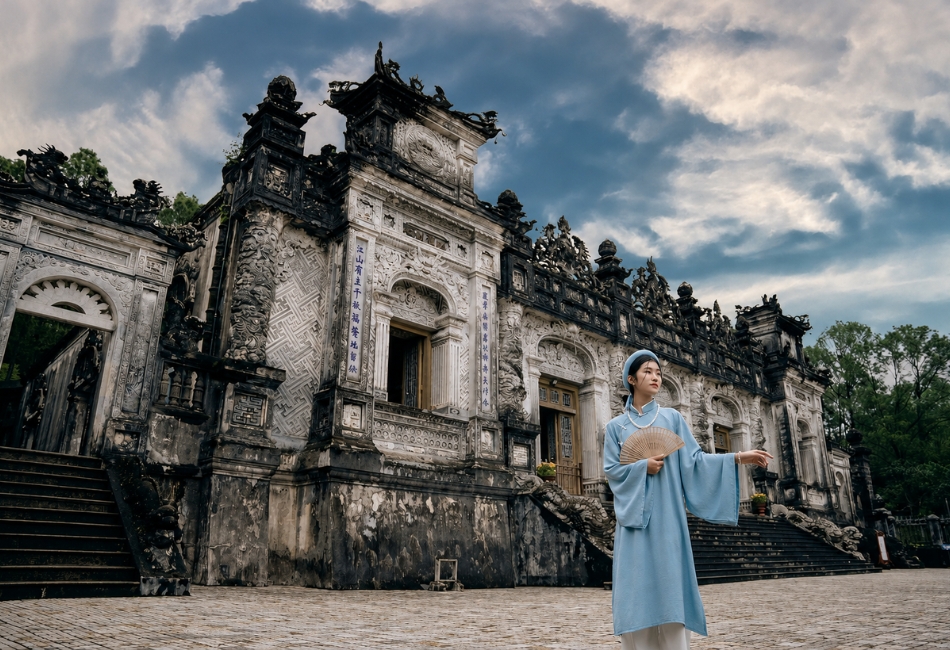
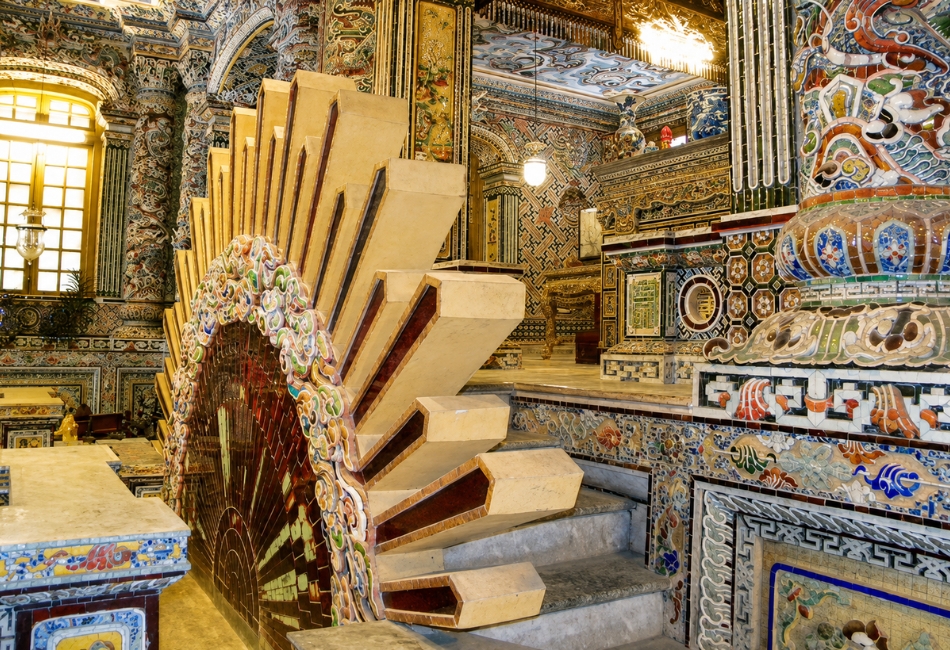
From the exterior, the monument can appear solemn and almost mysterious. Grey concrete walls rise from the green hillside, while dragons, stone pillars, and ceremonial statues create a powerful royal atmosphere. Inside Thien Dinh Palace, however, the mood changes completely. Visitors are welcomed by brilliant colours, detailed porcelain mosaics, gilded decoration, and an ornate ceiling mural.
This dramatic contrast between the dark exterior and colourful interior makes the tomb one of the most memorable places to visit in Hue.
2. The History Behind the Royal Tomb
Emperor Khai Dinh was the twelfth ruler of the Nguyen Dynasty. He reigned from 1916 until his death in 1925, during a period when Vietnam was under French colonial influence.
Construction of his royal tomb began in 1920. However, the project was not completed until 1931, six years after the emperor’s death. The monument therefore took approximately eleven years to build. Its completion was overseen by Emperor Bao Dai, Khai Dinh’s son and the last emperor of Vietnam.
The construction required a significant amount of labour, money, and imported materials. Iron, cement, roof tiles, glass, and porcelain were sourced from different regions and countries. Many of these materials were then adapted by Vietnamese craftspeople to create decorations filled with local symbols and traditional meanings.
The long construction period and the ambitious design explain why the Mausoleum of Emperor Khai Dinh looks so different from earlier Nguyen royal tombs. It reflects a transitional moment when Vietnamese imperial traditions were increasingly exposed to Western technology, architecture, and decorative styles.
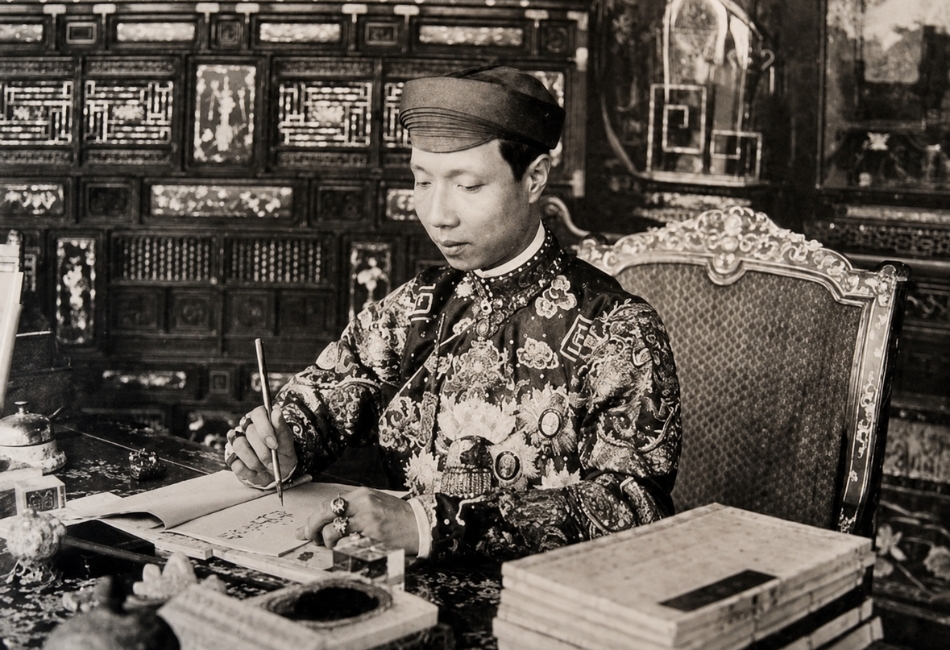
Born in 1885, Emperor Khai Dinh became ruler after Emperor Duy Tan was removed from the throne. His reign lasted nine years and remains a complex chapter in Vietnamese history.
From an artistic perspective, Khai Dinh was interested in architecture, fashion, decoration, and foreign influences. These preferences are clearly visible throughout his burial complex. Instead of copying the traditional design of earlier royal tombs, he commissioned a monument that combined different artistic ideas.
The result was a structure that remains controversial yet fascinating. Some visitors admire its creativity and elaborate details, while others see its heavy concrete design as a departure from Hue’s more graceful architectural traditions. Either way, the tomb provides valuable insight into the personality and era of the emperor who created it.
3. The Unique Architecture of the Mausoleum of Emperor Khai Dinh
The Mausoleum of Emperor Khai Dinh occupies a relatively compact area, but its position on a steep hillside gives it a monumental appearance. Rather than spreading horizontally through gardens and forests, the complex rises vertically through a sequence of terraces.
Visitors must climb more than 100 steps to reach the highest level. Along the way, each courtyard introduces new architectural details and symbolic decorations. The upward journey also builds a sense of anticipation before visitors enter Thien Dinh Palace.
The design blends several influences, including traditional Nguyen imperial architecture, Vietnamese religious symbols, European stone construction, and decorative features inspired by Gothic and Romanesque buildings.
3.1. The Grand Staircase and Dragon Railings
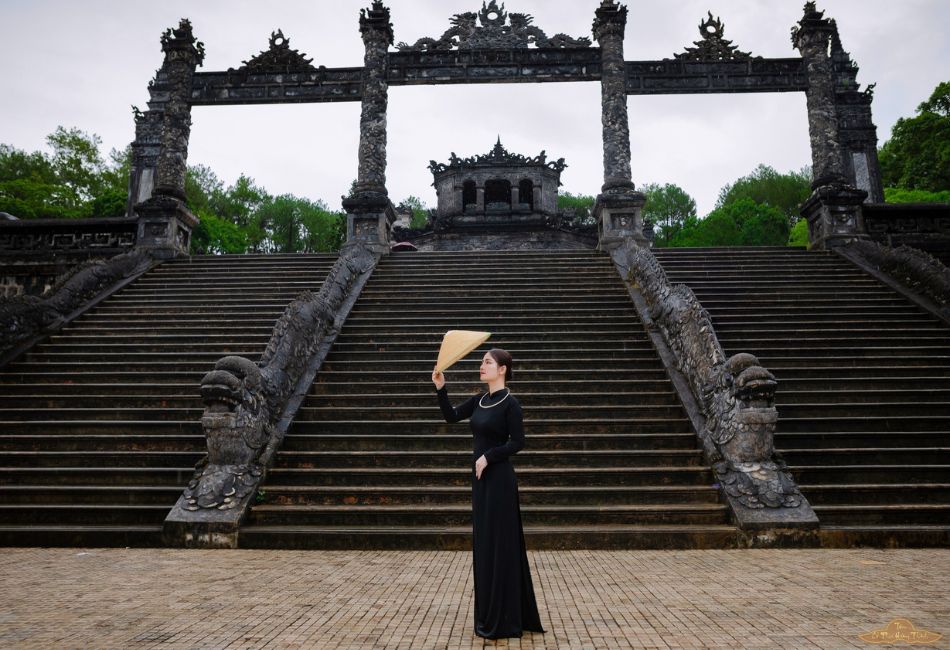
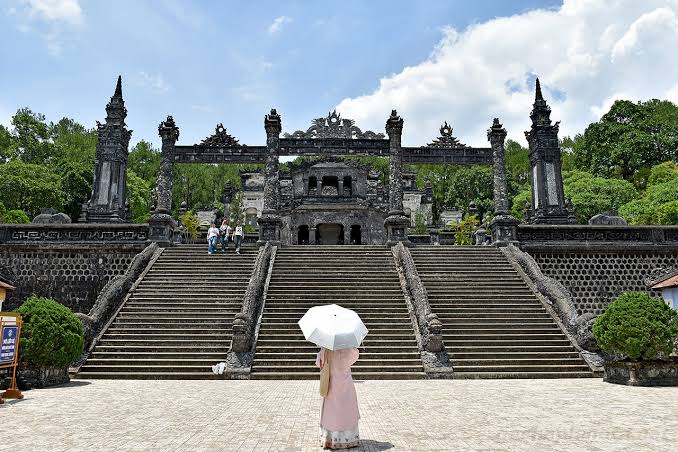
The visit begins with a steep staircase bordered by stone dragons. In Vietnamese royal culture, the dragon represented imperial authority, prosperity, and power. The dragon railings guide visitors toward the first entrance gate and establish the ceremonial character of the monument.
The staircase is one of the best-known views of the Mausoleum of Emperor Khai Dinh. Its strong symmetry, weathered stone, and dramatic perspective make it an excellent location for photography.
Because the steps can become slippery during wet weather, visitors should wear comfortable shoes and walk carefully. Taking short breaks also creates opportunities to look back at the surrounding hills and countryside.
3.2. The Nghi Mon Gate
At the top of the first staircase stands the imposing Nghi Mon Gate. Its tall columns and arched openings demonstrate the influence of European architecture, while dragons, clouds, and floral motifs maintain a clear connection to Vietnamese decorative traditions.
The gate feels more like a stone fortress than the wooden entrance of a conventional Vietnamese temple. This mixture of styles immediately distinguishes the Mausoleum of Emperor Khai Dinh from the other royal tombs around Hue.
Visitors should take time to examine the carved surfaces and repeating patterns. Many small details are easy to miss when moving quickly through the monument.
3.3. The Honour Courtyard and Mandarin Statues
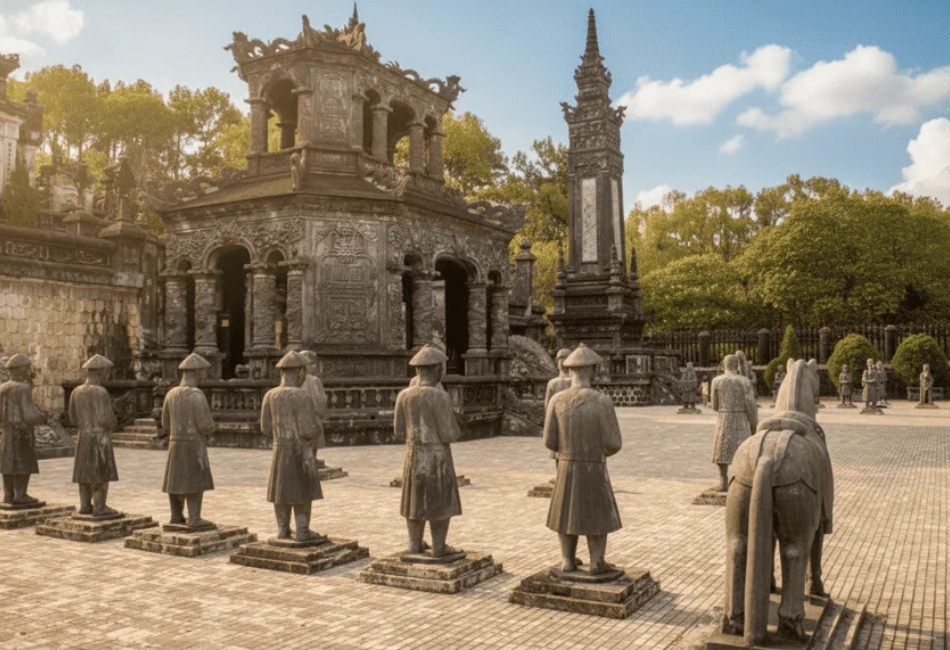
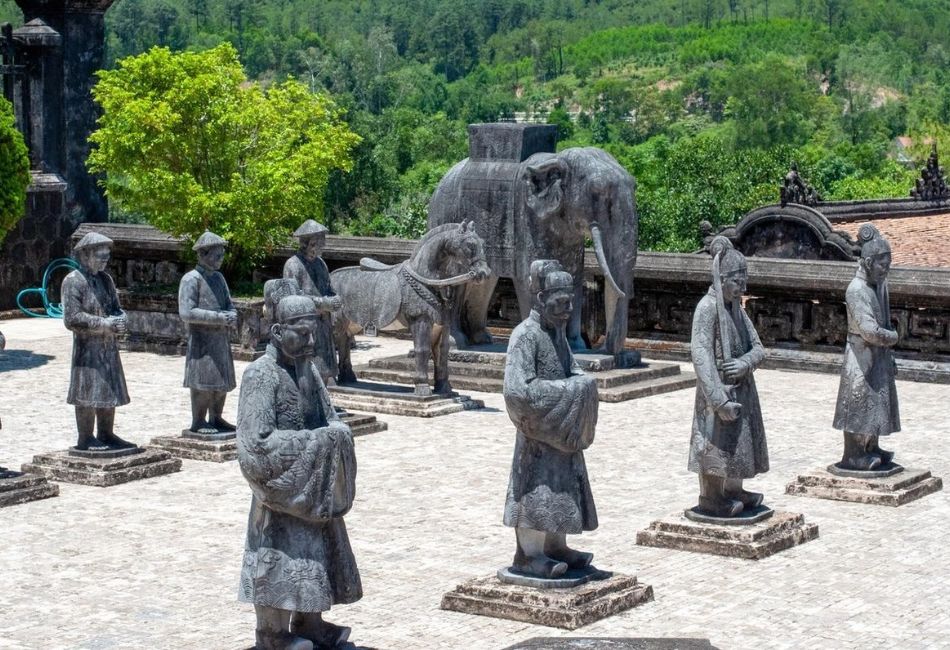
Continuing upward, visitors reach the Honour Courtyard, where rows of stone mandarins, horses, and elephants stand in ceremonial formation. These statues symbolically accompanied and served the emperor in the afterlife.
The statues at the Mausoleum of Emperor Khai Dinh are particularly interesting because they combine traditional court arrangements with realistic facial features and body proportions. Each figure appears to participate silently in a permanent imperial ceremony.
At the centre of this level is a stone pavilion containing a large stele. The inscription records the emperor’s life and achievements and was commissioned by Emperor Bao Dai in honour of his father.
From the courtyard, visitors can also appreciate the monument’s commanding position over Chau Chu Mountain. The surrounding vegetation creates a strong visual contrast with the grey stone structures.
3.4. Thien Dinh Palace: The Artistic Heart of the Tomb
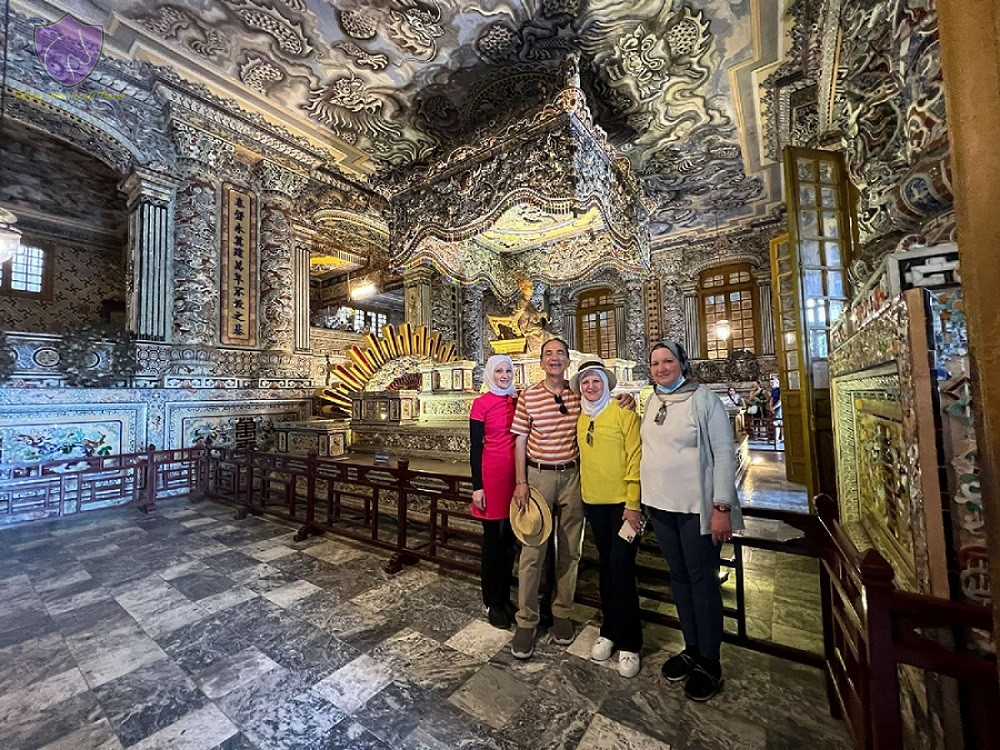
Thien Dinh Palace is located on the highest terrace and is the main highlight of the Mausoleum of Emperor Khai Dinh. While the exterior remains dark and imposing, the interior is filled with colour, light, and incredibly detailed decoration.
The palace is divided into several spaces used for worship, displaying royal objects, and housing the emperor’s burial area. Its walls and columns are covered with mosaics made from pieces of porcelain and coloured glass.
Dragons, phoenixes, flowers, clouds, trees, and scenes representing the four seasons appear across almost every surface. These images are not merely decorative. They express ideas connected to imperial authority, harmony, longevity, prosperity, and the natural world.
The mosaic work inside Thien Dinh Palace represents one of the highest achievements of decorative art in Hue. Instead of using flat painted patterns, artisans arranged thousands of broken ceramic and glass fragments to create textured images.
One of the most remarkable features is the ceiling painting commonly known as “Nine Dragons Hidden in Clouds.” The mural was created by royal artist Phan Van Tanh and remains an important example of early twentieth-century Vietnamese court art.
At the centre of the chamber is a bronze statue of Emperor Khai Dinh seated beneath an elaborate canopy. The emperor’s remains are believed to rest beneath the statue. A second statue nearby presents him in a standing position.
These richly decorated rooms make the interior of the Mausoleum of Emperor Khai Dinh feel surprisingly intimate despite the imposing character of its exterior.
4. What to Expect During Your Visit
Most travellers spend between 45 minutes and 1.5 hours exploring the monument. History and architecture enthusiasts may wish to stay longer, especially if travelling with a knowledgeable local guide.
A typical visit to the Mausoleum of Emperor Khai Dinh includes climbing the main staircase, exploring the ceremonial courtyards, examining the stone statues, visiting Thien Dinh Palace, and enjoying views of the surrounding landscape.
The site can become busy during weekends, public holidays, and the peak travel season. Arriving early in the morning offers a more peaceful atmosphere and softer light for photography. Late afternoon can also be pleasant, although visitors should allow enough time before the ticket office and monument close.
Photography Tips: The strong symmetry of the staircases and courtyards creates excellent compositions. Wide-angle photographs work particularly well at the main staircase, Nghi Mon Gate, and Honour Courtyard.
Inside Thien Dinh Palace, focus on the small artistic details rather than only photographing the entire room. The porcelain mosaics, dragon patterns, ceiling mural, and bronze statue all deserve individual attention.
When photographing the Mausoleum of Emperor Khai Dinh, visitors should avoid blocking narrow entrances or disturbing worshippers. Flash photography may be restricted in certain interior spaces, so always follow the instructions displayed at the site.
5. Practical Information for Visiting the Mausoleum of Emperor Khai Dinh
5.1. Location
The tomb is located in Chau Chu Mountain, in Thuy Bang Commune, approximately 10 kilometres southwest of central Hue. The journey usually takes around 20–30 minutes, depending on traffic and your form of transportation.
5.2. How to Get There
Travellers can reach the Mausoleum of Emperor Khai Dinh by private car, taxi, motorbike, or guided tour. Renting a motorbike provides flexibility, but a private car or organised tour is usually more comfortable during Hue’s hot or rainy weather.
For visitors who want historical explanations and convenient transportation, joining a Hue City Tour is an excellent option. A guided itinerary often combines Khai Dinh Tomb with the Imperial City, Thien Mu Pagoda, and another Nguyen royal tomb.
5.3. Opening Hours and Entrance Tickets
Opening hours and admission prices may change according to the season or local regulations. Visitors should check the latest information through the official Hue heritage authorities or ask their tour operator before departure.
Arriving at least one hour before closing time is recommended. This allows enough time to climb the terraces and explore the palace without rushing.
5.4. Best Time to Visit
The most comfortable period for visiting Hue is generally from February to April, when temperatures are often milder. However, the monument can be visited throughout the year.
During summer, early morning is the best choice because the stairs and courtyards offer limited shade. During the rainy season, bring a lightweight raincoat and wear shoes with reliable grip.
6. Combine the Tomb With Other Authentic Hue Experiences
The Mausoleum of Emperor Khai Dinh can easily be included in a full-day exploration of Hue’s imperial heritage. Each royal tomb has a distinctive character, so visiting more than one offers a deeper understanding of the Nguyen emperors.
Minh Mang Tomb is known for its balanced landscape, lakes, bridges, and traditional architecture. Tu Duc Tomb offers a poetic atmosphere surrounded by pine trees and water. Khai Dinh Tomb, by comparison, is compact, vertical, and richly decorated.
To experience these contrasts, consider booking a Hue Imperial City and Royal Tombs Tour. Travellers interested in local life can also explore villages, farmland, and traditional crafts on a Hue Countryside Tour.
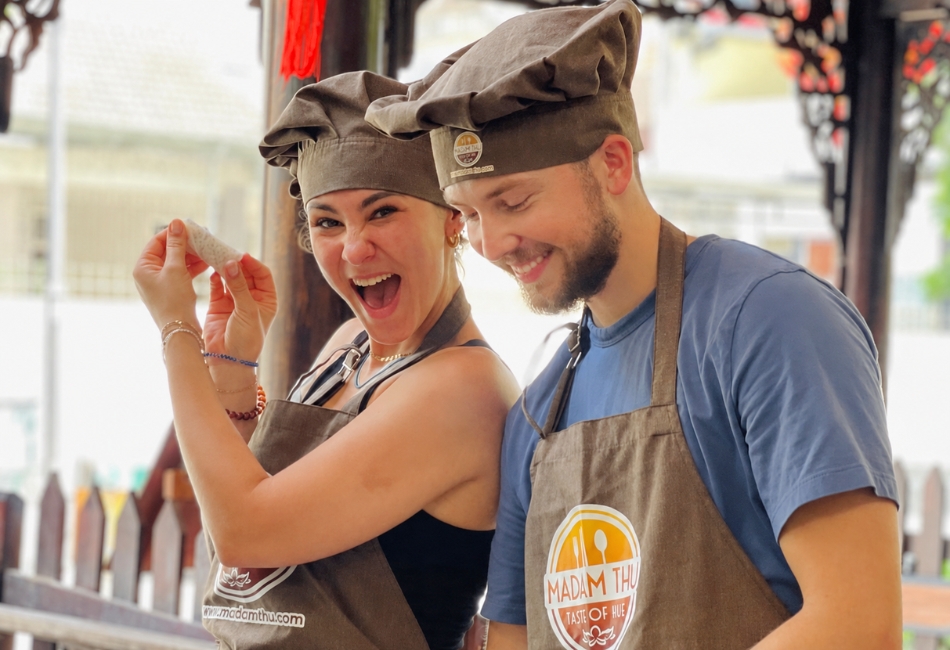
After discovering Hue’s royal history, food lovers may enjoy a hands-on Hue Vietnam Cooking Class or an evening Hue Street Food Tour. These experiences reveal another side of the city through its ingredients, family recipes, markets, and conversations with local people.
7. Final Thoughts
The Mausoleum of Emperor Khai Dinh represents a fascinating meeting point between Vietnamese imperial tradition and early twentieth-century European influence. Its grey stone exterior conveys strength and formality, while the interior reveals an unexpected world of colour, symbolism, and extraordinary craftsmanship.
From the dragon-lined staircases and silent mandarin statues to the porcelain mosaics of Thien Dinh Palace, every part of the monument tells a story about royalty, artistic ambition, and cultural change.
Whether you are passionate about history, architecture, photography, or local culture, the Mausoleum of Emperor Khai Dinh deserves a place on your Hue itinerary. Exploring it with a local guide can make the experience even more meaningful, helping you understand not only what you see but also the traditions and historical events behind this remarkable royal monument.
Recent Posts
How to Get Thien Mu Pagoda: Complete Hue Travel Guide

Incense Making Village Hue: Discover the Traditional Craft of Thuy Xuan